Article Summary:
- Hilo’s rainfall, humidity, vog, and trade wind patterns create installation conditions unlike anywhere else in the U.S.
- Local roofing knowledge—from corrugated metal to concrete tile—directly affects how safely and effectively solar is installed
- A contractor without genuine Big Island experience may spec the wrong equipment, mount panels incorrectly, or underestimate weather-related stress on your system
- Hawaii County permitting and HECO interconnection require familiarity that only comes from working in this specific market regularly
- Long-term roof integrity depends on how well your solar contractor understands the relationship between your mounting system and your specific roof type
- Choosing a locally rooted solar contractor in Hilo protects both your investment and your home
There’s a version of solar installation where everything is relatively straightforward. The roof is new, the pitch is ideal, the panels face south without a tree in sight, and the local utility has a simple interconnection process. That version exists somewhere. It’s just not Hilo.
Hilo is one of the most beautiful and genuinely challenging environments in the country for a solar installation. The rain comes in sideways some afternoons. The humidity is persistent enough to corrode hardware that would last decades on the mainland. The roofing stock is diverse—you’ll find everything from 70-year-old corrugated metal on plantation-era homes to poured concrete on mid-century construction to standing seam metal on newer builds—and each type requires a different mounting approach. Then there’s the vog, the occasional salt air events, the wind uplift considerations tied to Hawaii’s hurricane exposure category, and the very specific requirements of working with Hawaiian Electric on the Big Island.
All of that shapes what good solar installation actually looks like here. And all of it is why local experience—not just Hawaii experience, but specifically Big Island, east-side, Hilo-area experience—matters so much when you’re choosing a solar contractor.
This article gets into the specifics. Why local roofing knowledge protects your home. What climate factors actually affect your system’s long-term performance. How a contractor’s familiarity with Hawaii County permitting and HECO interconnection affects your project from start to finish. And what you should be looking for when you evaluate whether a contractor genuinely knows what they’re doing in this market.
The Roof Is the Foundation of Everything
When homeowners think about solar installation, they tend to think about the panels—the efficiency ratings, the aesthetics, the brand names. The roof underneath those panels gets far less attention. But from a contractor’s perspective, the roof is where the entire installation either succeeds or fails over the long term.
Every penetration made into a roof during a solar installation is a potential entry point for water if it’s not handled correctly. Every mounting bracket transfers the weight and wind load of your panel array into your roof structure. The integrity of the system 15 years from now depends substantially on decisions made about your roof on installation day—decisions that require genuine knowledge of the specific roofing materials and construction methods common in Hilo.
A solar contractor who mostly works on simple composition shingle roofs in a dry mainland climate can follow a training manual to install on a flat-seam metal roof or a Hawaiian-style corrugated metal roof. But knowing how to do it right—selecting the correct flashing type, understanding how tropical thermal expansion affects different metal roofing materials, knowing which sealants hold up in Hilo’s persistent humidity and which break down within a few years—that comes from doing it repeatedly in this specific environment.
Hilo’s Roofing Landscape: What’s Actually Out There
To understand why local roofing experience matters, it helps to appreciate how varied the housing stock in Hilo actually is.
Corrugated Metal Roofing
Corrugated metal roofing is deeply embedded in Hawaii’s architectural history. You see it everywhere in older Hilo neighborhoods—in Wainaku, downtown Hilo, Keaukaha, and throughout the Puna district on the road toward the coast. Many of these roofs are on well-built, structurally sound homes that will be standing for another 50 years. They’re also among the most technically demanding surfaces for solar installation.
Corrugated metal roofs have a ribbed profile—alternating raised ridges and flat valleys running down the slope. The correct way to mount solar on this roofing type is using specifically designed corrugated metal roof mounts that attach through the raised ribs, not through the flat panel areas between ribs. Drilling through the flat panel portions creates a penetration that sits in the drainage path and is far more prone to leaking.
An experienced Hilo contractor knows this from years of working on these roofs. They carry the right hardware—S-5! clamps or equivalent rib-mount systems designed for corrugated metal—and they understand the specific torque requirements for different metal gauges to create a watertight connection without deforming the metal.
A contractor without that local experience may use generic L-foot mounts with through-bolt penetrations in the flat panel sections, which is a faster installation that creates a slower, harder-to-diagnose leak problem that doesn’t show up until the next good rainstorm.
Standing Seam Metal Roofing
Standing seam metal roofs—characterized by vertical panels with raised seams running from ridge to eave—are increasingly common on newer Hilo construction and on homes that have upgraded from older roofing materials. They’re durable, well-suited to tropical climates, and actually ideal for solar installation when approached correctly.
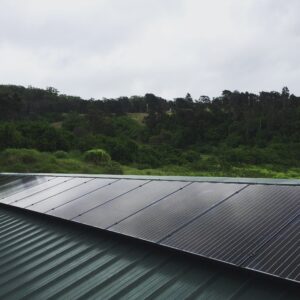
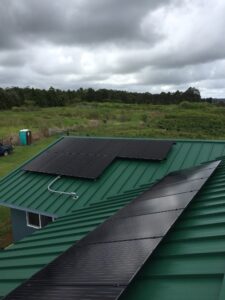
The key word is correctly. Standing seam roofs should be mounted using non-penetrating clamps that attach directly to the raised seams—no drilling, no penetrations into the roof surface at all. Products like S-5! clamps are designed specifically for this purpose and preserve the roof’s water integrity completely.
A contractor who drills through a standing seam metal roof to mount solar is doing it wrong. Full stop. That drilling voids the roofing warranty, creates penetration points that can rust and leak, and is simply unnecessary when proper seam-clamp hardware exists. Knowing the difference—and having the right hardware on the truck—is a basic marker of local competence.
Concrete Tile and Clay Tile
Tile roofing—both concrete tile and clay tile—shows up throughout Hilo’s residential neighborhoods, particularly on homes built in the 1980s through 2000s. It’s an attractive roofing material that performs reasonably well in tropical climates, but it presents specific challenges for solar installation.
Tile is brittle. Walking on it incorrectly breaks it. Mounting solar on tile roofing requires removing individual tiles in the locations where mounting hardware will be installed, setting flashed standoffs or tile hooks onto the roof deck, and then replacing the surrounding tiles in a way that maintains water drainage. Done correctly, you’d barely know the mounting hardware is there. Done carelessly, you get cracked tiles, compromised flashing, and a roof that leaks the next time a tropical storm pushes rain sideways across your roofline.
Experienced local contractors have developed techniques for tile work that minimize breakage and maintain roof integrity. Less experienced crews often cause visible tile damage during installation—a problem that looks cosmetic but can be structural when it affects the waterproofing layer.
Flat and Low-Slope Roofing
A meaningful portion of Hilo’s housing stock—particularly older concrete block construction and some commercial-adjacent residential buildings—features flat or very low-slope roofing. These roofs are waterproofed with modified bitumen, TPO membrane, or in older construction, built-up tar-and-gravel systems.
Solar on flat roofs typically uses ballasted racking systems—frames weighted down with concrete blocks that hold panels at a tilted angle without any roof penetrations at all. This approach eliminates the waterproofing risk of penetrations entirely. But ballasted systems need to be engineered correctly for wind uplift and distributed weight load, both of which matter significantly in Hawaii’s wind exposure zone.
An experienced contractor will assess a flat roof’s condition and structural capacity before recommending any system. Older built-up roofing may need repair or replacement before solar goes on—something worth knowing before, not after, installation.
Asphalt Composition Shingles
While less prevalent in Hilo than in drier parts of the country, composition shingle roofing does appear on many homes, particularly newer construction or homes that have been re-roofed in recent decades. Shingle roofing is generally the most straightforward surface for solar mounting—standard flashed L-foot mounts with proper asphalt roofing sealant are well understood and widely practiced.
Even here, though, local experience matters: the sealants and flashing products that perform well in Hilo’s humid, high-rainfall environment are not necessarily the same ones that perform well in a drier climate. A contractor who knows the local conditions will specify butyl-based or polyurethane sealants rated for tropical environments rather than the standard silicone products that may degrade faster under persistent moisture exposure.
How Hilo’s Climate Affects Solar Hardware Over Time
Your solar system doesn’t just sit on your roof looking attractive. It lives there through 130 inches of rain per year, persistent tropical humidity, occasional vog events, trade wind loads, and the rare but real threat of passing tropical storms. The hardware connecting your panels to your roof needs to be chosen with all of that in mind.
Corrosion: The Slow Enemy
Corrosion is the primary long-term hardware threat in Hilo’s environment, and it’s one that mainland-trained contractors sometimes underestimate. The combination of persistent humidity, occasional salt air intrusion from coastal proximity, and mild acid content from vog creates conditions that accelerate corrosion in metals not specifically rated for tropical or coastal environments.
Standard zinc-coated (galvanized) hardware that might last 30 years in a dry climate can show significant corrosion within 5-10 years in Hilo. Aluminum components without proper anodizing or protective coatings can pit and weaken over time. Stainless steel—particularly 316 marine-grade stainless—performs significantly better in this environment, but it costs more and requires a contractor who knows when to specify it.
The practical implication: ask any contractor you’re considering what specific hardware grades they use for roof attachments, wire management, and conduit in Hilo’s climate. A contractor who defaults to whatever hardware ships in the standard racking kit without considering local environmental conditions is not paying adequate attention.
The failure mode for corroded mounting hardware isn’t always dramatic. It often manifests as gradual loosening of connections over years, which can allow panels to shift slightly under wind loading—stressing the panel frame, the wiring connections, and the roof attachment points. By the time you notice something is wrong, the repair is more involved than it would have been if the right hardware had been specified from the start.
Wind Uplift and Hurricane Exposure
Hawaii is classified in a high wind zone for building code purposes, and the Big Island carries additional exposure considerations given its geographic position. Solar panel arrays are essentially large horizontal surfaces attached to your roof—they behave like a sail in high winds, and the forces they transfer to the mounting system and roof structure during a significant wind event are substantial.
Hawaii County’s building code requires solar installations to be engineered for specific wind uplift values. The permit application process includes engineering calculations demonstrating that the mounting system can handle the required loads. But engineering calculations are only as good as the inputs, and the inputs need to reflect Hilo’s actual wind exposure—not generic statewide assumptions or, worse, mainland code defaults.
A locally experienced contractor has processed permit applications in Hawaii County many times. They know what the building department expects, they have engineering relationships for structural review when needed, and they’ve had their installation methods validated through the county inspection process repeatedly. That track record of successful permitted and inspected installations in Hawaii County is a meaningful indicator of competence.
Thermal Expansion in Tropical Heat
Metal expands and contracts with temperature changes. In Hilo, where daytime temperatures can climb significantly on sunny days before afternoon rain cools things down, metal roofing and metal racking components cycle through thermal expansion and contraction regularly. Over years, this cycling can work fasteners loose if they weren’t installed with appropriate torque and, in some cases, thread-locking compounds.
Experienced local installers account for thermal movement in how they route and secure wiring, how they torque mounting hardware, and how they select expansion-tolerant conduit fittings. These are details that don’t show up in a proposal document, but they show up in system longevity.
Rain Intrusion and Drainage
Hilo averages more annual rainfall than almost any other city in the United States. Water management around roof penetrations and conduit entry points isn’t a secondary concern here—it’s a primary design consideration.
Every point where a wire or conduit enters a building, every roof penetration for a mount, and every conduit junction box needs to be properly sealed and positioned to shed water rather than collect it. Standard electrical practice calls for conduit to enter building envelopes from below or with appropriate weatherhead fittings. In Hilo’s rainfall environment, extra attention to these details isn’t excessive caution—it’s basic professional practice.
A contractor who has worked extensively in Hilo develops an instinct for water management that comes from seeing what happens when it’s done poorly. That experience shows up in small installation details that collectively make the difference between a system that stays weathertight for 25 years and one that develops moisture issues within the first decade.
What Local Permitting Experience Actually Gets You
Hawaii County’s building permit process for solar installations is more involved than many mainland jurisdictions, and familiarity with that process has direct, practical value for your project.
Permit Application Quality
A permit application for a solar installation in Hawaii County includes structural drawings, electrical diagrams, and engineering calculations. Applications that are complete, correctly formatted, and consistent with what the department expects get processed without kickback. Applications that are missing information, use incorrect drawing formats, or fail to address specific Hawaii County requirements get returned for correction—a process that can add weeks to your timeline.
A contractor who regularly submits permits to Hawaii County knows exactly what the department expects. They maintain relationships with plan reviewers, they understand which details need to be shown explicitly versus what can be referenced by code, and they submit applications that move through the process efficiently.
For a homeowner, this matters because the time between contract signing and installation day is largely determined by permit turnaround. A contractor who nails the permit application the first time compresses that wait. A contractor whose application gets kicked back once or twice for corrections extends it—sometimes significantly.
Navigating Hawaii County Inspections
After installation, a Hawaii County building inspector visits to verify that the work matches the permit drawings and meets code requirements. Inspections can fail—for missing cover plates, incorrect wire sizing, labeling requirements, clearance issues around electrical equipment, or dozens of other code-compliance details.
A failed inspection requires corrections and a reinspection, adding time and sometimes cost to your project. Contractors who work regularly in Hawaii County know the inspection requirements thoroughly and install to pass the first time. That’s not luck—it’s the product of repeated experience with the same inspectors, the same requirements, and the same code standards.
HECO Interconnection: A Process That Rewards Familiarity
Hawaiian Electric’s interconnection application process for Big Island customers has its own requirements, timelines, and communication protocols that differ in important ways from other utilities and other islands. A contractor who regularly handles interconnection applications with HECO’s Big Island team knows the current state of program availability, how to handle application requests for clarification, and what documentation HECO typically requires at each stage.
This familiarity has real-world implications. Interconnection applications that are complete and correctly submitted move through HECO’s queue faster than those that require back-and-forth clarification. A contractor who handles dozens of Hilo-area HECO interconnection applications per year has a practical efficiency advantage over one doing their first or second.
There’s also a subtler point: HECO’s tariff programs and requirements for the Big Island have changed meaningfully over the years, and they may change again. A contractor who’s been working in this market continuously is current on those changes. One who works primarily elsewhere and does occasional Big Island projects may be working from outdated knowledge about program availability, sizing limitations, or export compensation structures.
The Relationship Between Roof Age and Solar Installation
One of the most important conversations a local solar contractor should have with you before installation is about the condition and remaining life of your roof. This conversation is particularly relevant in Hilo, where heavy rainfall accelerates wear on roofing materials and where the housing stock includes a significant number of older homes.
Why Roof Assessment Matters Before Solar Goes On
Installing solar on a roof that needs replacement in the next few years creates a problem down the road. When that roof eventually needs to be replaced, the solar system has to come off first—and then go back on after the new roof is installed. The cost of that removal and reinstallation can run several thousand dollars depending on system size, and it’s entirely avoidable if the roof condition is properly assessed before solar installation begins.
A locally experienced contractor will look at your roof carefully during the site assessment—not just to determine mounting logistics, but to evaluate whether the roofing material has enough remaining life to justify installing solar on it right now versus recommending a re-roof first.
For Hilo homeowners with older corrugated metal roofs, this assessment includes looking for rust development, fastener corrosion, and any areas where the metal has thinned or lost its coating. For tile roofs, it means checking for cracked or missing tiles and the condition of the underlayment. For flat roofs, it means evaluating the membrane for delamination, bubbling, or existing patched areas that indicate a compromised waterproofing layer.
None of this requires an exhaustive roofing inspection, but it does require enough roofing knowledge to make a reasonable judgment—knowledge that comes from years of working on Big Island homes.
Having the Honest Conversation
Some solar contractors, particularly those operating under aggressive sales targets, are reluctant to tell a homeowner that their roof needs work before solar goes on. Recommending a re-roof first delays the sale, adds cost to the homeowner’s near-term expenses, and risks losing the deal entirely.
A contractor who prioritizes their relationship with you over a quick sale will have this conversation honestly. They’ll tell you if they see something that warrants a roofing assessment before installation. They’ll tell you if they think your roof has three to five years left before it needs replacement and help you think through whether to re-roof now or wait on solar. That kind of honest guidance is a service—and it’s a marker of a contractor who’s thinking about your long-term interests, not just the installation day transaction.
Local Knowledge in System Design: Beyond Just the Roof
Local experience affects more than just installation technique. It shapes the entire system design process in ways that matter for your long-term satisfaction with your solar investment.
Knowing Which Neighborhoods Get Sun—and When
Hilo’s weather patterns are famously hyperlocal. The town sits at the base of Mauna Kea and Mauna Loa, and the interaction of trade winds with that terrain creates distinct microclimates within short distances of each other. Neighborhoods closer to the bay tend to get more consistent morning sun with afternoon cloudiness rolling in. Areas up toward Kaumana or further toward Volcano can be in cloud cover for significant portions of the day. Puna neighborhoods to the south face their own sun and vog patterns.
A contractor who has designed and monitored systems throughout Hilo’s neighborhoods over multiple years has actual production data from real installed systems across these microclimates. That real-world data is more valuable than any satellite-derived solar resource estimate for predicting what your specific system will actually produce.
Vegetation and Shading Patterns
Hilo is lush—genuinely, beautifully lush. It’s also covered in fast-growing tropical vegetation that can significantly affect solar production through shading. Trees that cast minimal shade on your roof today may create meaningful shading in five years if not managed.
A locally experienced contractor has seen this play out on systems they’ve installed and maintained. They know which tree species common in Hilo grow quickly enough to warrant planning for future shading, and they can advise you on panel placement that maximizes useful life before vegetation becomes an issue. They may also factor shading management into their system design recommendations—whether that means microinverters for shade tolerance, or a specific panel layout that keeps the most productive portions of your roof unshaded even as surrounding vegetation matures.
Understanding Your Specific HECO Service Area
The Big Island’s electrical infrastructure is not uniform. Different neighborhoods have different grid conditions, transformer configurations, and sometimes specific HECO requirements that affect interconnection. A contractor with extensive local history knows these nuances—and knows when to ask HECO questions proactively rather than discovering issues mid-application.
What Long-Term Local Presence Actually Means for You
There’s a practical dimension to choosing a locally rooted solar contractor in Hilo that goes beyond the technical: it’s about who you can call in year seven when something needs attention.
Warranty Service Is Only Valuable If the Company Is Still Around
Solar warranties—particularly the 10-year workmanship warranty that good contractors provide—are promises about the future. A company that was operating in Hilo when they installed your system needs to still be operating in Hilo when you need warranty service. That seems obvious, but the solar industry has seen meaningful consolidation and attrition, particularly among companies that expanded aggressively during incentive booms without the financial foundation to sustain operations through slower periods.
Choosing a contractor with demonstrated staying power in the Hilo market—years of continuous local operation, a physical local presence, a team of local employees—reduces the risk that you’ll need warranty service and find the company gone or no longer servicing Hawaii Island.
Community Accountability
A contractor whose business is genuinely embedded in the Hilo community has reputational stakes that a national company or a mainland-based operator sending crews to Hawaii periodically simply doesn’t have. When you see the owner of your solar company at KTA or at a Hilo High football game, there’s an accountability dynamic that matters in ways that don’t show up in any contract clause.
This isn’t about small businesses being inherently better than larger ones. It’s about the value of a contractor who has genuine long-term community ties that make customer satisfaction a personal priority rather than just a business metric.
Local Supplier Relationships
A contractor who has been working in Hilo for years has established relationships with local suppliers, electricians, roofing subcontractors, and equipment distributors. Those relationships mean faster procurement when a replacement part is needed, reliable subcontractor availability for electrical panel work that’s outside the solar crew’s direct scope, and the kind of informal knowledge network that only comes from years of working within a specific community.
On the mainland, parts logistics are relatively straightforward. On the Big Island, getting a specific piece of equipment quickly can require creative supply chain problem-solving. A contractor with local supplier relationships navigates that more effectively than one who’s ordering everything from the mainland on standard freight timelines.
Questions That Reveal Whether a Contractor Truly Knows Hilo
When you’re evaluating solar contractors, a few targeted questions can quickly reveal whether someone has genuine local experience or is presenting general solar knowledge as though it’s Hilo-specific expertise.
Ask about roof-specific experience: “What mounting system do you use for corrugated metal roofs, and can you walk me through the process?” A contractor who actually installs on these roofs regularly will give you a specific, confident answer about rib-mount hardware and their approach to sealing. Vague answers suggest limited experience with this roofing type.
Ask about local weather considerations: “How do you account for vog in your production estimates for Hilo systems?” A contractor who works regularly in Hilo will know that vog affects irradiance and can speak to how they handle it in system modeling. A contractor importing generic approaches from sunnier markets may not have thought about it at all.
Ask about specific neighborhood production: “Have you installed systems in [your neighborhood]? What kind of production are those systems seeing?” A contractor with real local history should be able to give you a meaningful answer based on monitored systems they’ve installed nearby.
Ask about HECO Big Island specifics: “What’s the current status of interconnection queue times for residential CSS applications on the Big Island?” This is a specific operational question that a contractor actively doing business in this market will know, and one that a contractor with limited local presence may struggle to answer accurately.
Ask about roof condition assessment: “Before you finalize a design, how do you assess whether a roof is in good enough condition for solar?” A contractor with genuine local experience will walk you through their roof evaluation process. One without it may give a generic answer that doesn’t reflect the specific roofing challenges common in Hilo.
The Difference Between Hawaii Experience and Hilo Experience
This distinction is worth making explicitly: not all Hawaii solar experience is equivalent. The solar market on Oahu operates in a significantly different environment—more competition, denser customer base, different HECO operational structure, different roofing stock in newer residential developments, and different logistical considerations than the Big Island.
A company that has installed hundreds of systems on Oahu and is now expanding to the Big Island is not the same as a company that has been operating in Hilo for years. Oahu experience is valuable, but it doesn’t automatically translate to competency with Hawaii Island’s specific roofing stock, Hawaii County’s permitting process, Big Island HECO interconnection, or the east-side climate conditions that shape system design here.
Similarly, Kona and the west side of the Big Island operate in a meaningfully different environment than Hilo. The Kona coast is significantly drier, sunnier, and less affected by vog than the Hilo side. A contractor whose experience is predominantly on the sunny west side is not necessarily well-prepared for the roofing conditions, rainfall management considerations, and production modeling challenges specific to Hilo and the wet side of the island.
When a contractor talks about local experience, ask them to be specific: How many systems have you installed in Hilo and the east side of the Big Island? How long have you been doing work in Hawaii County specifically? Those numbers tell you far more than a general claim of “Hawaii experience.”
Putting It Together: What to Look for in a Hilo Solar Contractor
Based on everything covered in this article, here’s the practical summary of what local experience should look like in a qualified solar contractor in Hilo:
A contractor worth considering for your Hilo home should be able to demonstrate several years of continuous operation on the Big Island—not just occasional projects, but regular, ongoing business with established permitting history in Hawaii County. They should have specific, articulate knowledge of the roofing types common in Hilo and the mounting approaches appropriate for each. They should be current on HECO’s tariff programs and interconnection requirements for Big Island residential customers, and they should factor that knowledge directly into their system design recommendations.
They should use hardware—racking components, fasteners, conduit fittings—rated for tropical coastal environments, and they should be able to explain why they specify what they do. They should conduct a genuine roof assessment as part of their site evaluation and be willing to have honest conversations about roof condition even when that conversation might complicate the sale.
They should have local references—real Hilo homeowners whose systems have been running long enough to reveal how the company handles post-installation issues. And they should have a visible local presence: an address, a phone number that reaches someone in the community, and a team of people who are genuinely embedded in Hilo rather than flying in for installations.
That combination of technical competence, local knowledge, and community presence is what you’re looking for. It doesn’t guarantee a perfect experience—nothing does—but it gives you the best realistic foundation for an installation that protects your roof, performs well in Hilo’s specific climate, and is backed by a contractor who will be around when you need them.
Solar Saint: Built for Hilo, Ready for Your Roof
At Solar Saint, we do this work here in Hilo. Not occasionally, not as part of a regional expansion—here, full-time, year-round. We know what corrugated metal roofs look like from the inside. We know what the building department expects on a permit application. We know what HECO requires for Big Island interconnection. And we know what Hilo’s weather does to hardware that isn’t spec’d for this environment.
When we design a system for your home, we do it based on your actual roof, your actual HECO bills, and our actual knowledge of how systems perform on the east side of the Big Island. When something needs attention after installation, we’re not sending someone from the mainland or coordinating across islands—we’re down the road.