
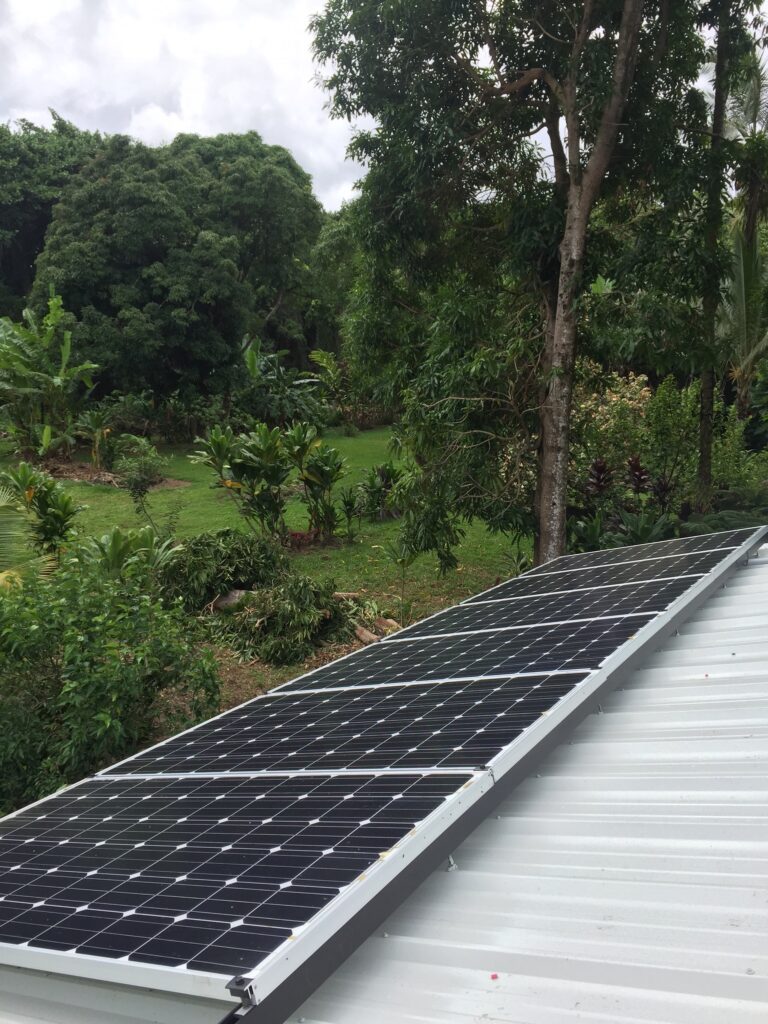
Article Summary:
- Hawaii’s isolated Pacific location exposes Big Island solar systems to real hurricane and tropical storm risk—and Hilo homeowners need to understand what that means for their installation before, during, and after a storm event
- Properly engineered and permitted solar installations in Hawaii are designed to withstand significant wind loads—but installation quality determines whether that engineering holds up in practice
- Battery storage changes the storm preparedness equation significantly, allowing Hilo homeowners to maintain power through grid outages that hurricane events commonly cause on the Big Island’s isolated grid
- Homeowners’ insurance coverage for storm-damaged solar systems has specific requirements—permitted installations by licensed contractors are a baseline condition most policies require
- Post-storm inspection protocols matter as much as pre-storm preparation—knowing what to check and when to call a professional protects both your system and your roof
- The best protection against hurricane damage to your solar system is proper installation from the start—using hardware engineered for Hawaii’s wind zone and installation practices that don’t create vulnerabilities
- Because securing permits and HECO approval can take several months, exploring solar installation timelines in Hilo helps you schedule your build with enough buffer to prepare for severe weather.
Hawaii sits in the central Pacific in a position that makes it genuinely vulnerable to tropical cyclone activity. While direct hurricane strikes on the Hawaiian Islands are relatively rare compared to the Atlantic and Gulf Coast hurricane belts, the Big Island has experienced real tropical storm and hurricane impacts—and the threat is present enough that every Hilo homeowner with solar panels should understand what it means for their system.
The 2018 season that brought Hurricane Lane close enough to dump historic rainfall on Hilo, the periodic tropical storm activity that crosses the central Pacific each summer and fall, and the background reality of living on an island in one of the most active ocean basins in the world all reinforce that storm preparedness is a legitimate part of solar ownership on the Big Island—not an abstract concern for somewhere else.
This article covers what you actually need to know about hurricanes, tropical storms, and your solar panel system in Hawaii. How wind loading affects solar installations and what the engineering behind your system is designed to handle. What the real risks are and where they come from. How battery storage changes your storm preparedness picture. What your insurance covers and what it requires. What to do before a storm, during a storm, and after one passes. And what the difference between a properly installed system and an inadequate one looks like when serious wind events test them.
Hawaii’s Tropical Storm and Hurricane Risk: The Real Picture
Understanding the actual risk environment helps you calibrate your preparedness appropriately—neither dismissing the concern nor treating every tropical storm advisory as a catastrophic threat.
The Central Pacific Hurricane Season
The Central Pacific hurricane season officially runs from June 1 through November 30, with peak activity typically in July through September. The National Hurricane Center and the Central Pacific Hurricane Center track systems that develop in or enter this basin, which covers the Hawaiian Islands and surrounding waters.
The Big Island’s position as the southernmost and easternmost of the main Hawaiian Islands means it receives the most direct exposure to systems tracking from the east or southeast. Historical storm tracks show that most central Pacific hurricanes pass south of the island chain—but enough exceptions exist in the historical record that the risk can’t be dismissed.
Hurricane Iselle in 2014 made landfall on the Big Island’s Puna district as a tropical storm—the first tropical cyclone to make landfall in Hawaii in recorded history—causing significant damage to structures and vegetation in lower Puna. Hurricane Lane in 2018, while not making direct landfall, tracked close enough to dump over 50 inches of rain on Hilo in a short period and produced hurricane-force gusts in exposed areas. These events are reminders that the Big Island’s storm exposure is real even when direct landfalls remain relatively infrequent.
What Makes the Big Island’s Storm Risk Distinctive
The Big Island’s topography creates a complex storm interaction environment. Mauna Kea and Mauna Loa—both rising above 13,000 feet—deflect, channel, and intensify wind flows during storm events in ways that create highly localized wind conditions across different parts of the island. Hilo, on the windward east side of the island, experiences a different wind environment during storm events than Kona on the leeward west side.
During strong trade wind events and tropical systems, the Hilo side typically experiences the more significant rainfall and sustained wind effects—consistent with Hilo’s prevailing wet, windward climate. The interaction of storm circulation with the island’s terrain can produce localized wind acceleration in valleys and channels that exceeds the overall storm’s reported surface wind speeds.
This terrain-influenced wind behavior is part of why Hawaii’s building code specifies wind loads for solar installations that are more demanding than many mainland jurisdictions—and why installation quality that meets those specifications matters in ways that casual observers might not fully appreciate.
The Grid Vulnerability Factor
Beyond direct physical damage to solar systems, tropical storms and hurricanes create a specific vulnerability for Big Island households: grid outages. The Big Island’s electrical grid is an isolated island system with no connections to neighboring islands or the mainland. When storms damage HECO’s distribution infrastructure—transmission lines, substations, transformers—the grid goes down and stays down until repairs are made.
The 2018 events in lower Puna demonstrated how extended grid outages can be in the aftermath of significant storm events in Hawaii. Some Puna households were without grid power for weeks following the combination of hurricane rainfall and the subsequent volcanic activity that damaged infrastructure.
For solar customers without battery storage, a grid outage means no solar power—grid-tied systems are required to shut down when HECO’s grid is not present for safety reasons. For solar customers with battery storage sized for meaningful backup, a grid outage is a manageable inconvenience rather than a crisis.
How Solar Installations Are Engineered for Hawaii’s Wind Environment
The most important thing Hilo homeowners should understand about hurricanes and their solar system is that a properly designed and installed system is specifically engineered for Hawaii’s wind conditions—not designed for a generic national standard and then deployed in a high-wind environment.
Hawaii’s Wind Zone Classification
Hawaii’s building code classifies the state in a high wind exposure zone, with specific design wind speed requirements that exceed those of many mainland jurisdictions. The code requirements for solar installations on Big Island residential structures reflect these elevated wind loads through specific structural calculations that must be submitted as part of the Hawaii County permit application for every solar installation.
These calculations address two primary structural concerns:
Wind uplift on the panel array. During high-wind events, the airflow over and around a solar panel array creates lift forces—similar to the aerodynamic forces that allow aircraft wings to generate lift—that try to pull the panels away from the roof. The mounting system must resist these uplift forces with sufficient margin to remain intact at the code’s design wind speed.
Wind pressure on the roof penetrations. The attachment points that connect the racking system to the roof structure transfer all of those uplift forces into the building. Each attachment point must be engineered to handle its share of the total load without pulling out of the roof structure or creating structural damage.
Racking system lateral loads. Wind doesn’t just push upward—it also creates lateral forces on the panel array that the racking system must resist without distorting or failing.
The structural engineering calculations in a permitted Hawaii County solar installation specifically demonstrate that the proposed mounting configuration can handle these loads at the code’s required design wind speed. This documentation isn’t bureaucratic formality—it’s the engineering basis for a system that should remain intact during storm events.
What the Engineering Means in Practice
A solar installation that has been properly engineered for Hawaii’s wind zone and installed in accordance with that engineering should be capable of withstanding a Category 1 hurricane’s wind speeds—roughly 74 to 95 mph sustained—without panel loss or structural failure. Well-engineered and well-installed systems have demonstrated survival through significantly stronger wind events in comparable high-wind markets.
The qualification “properly engineered and installed in accordance with that engineering” is doing important work in that statement. The engineering calculations in the permit are only as good as the installation that follows them. If the structural engineering specifies attachment points at certain spacing with specific hardware, and the installation crew uses different spacing or different hardware, the installed system may not achieve the engineered wind resistance the drawings implied.
This is one of the most direct connections between contractor quality and storm performance. A contractor who pulls permits with complete engineering calculations and then installs according to those specifications produces a system that performs as designed in high-wind conditions. A contractor who uses the engineering as permit documentation but cuts corners in the field installation—wider attachment spacing, lighter hardware, inadequate sealant—produces a system that may fail at wind speeds the engineering suggested it should handle.
What Hawaii Code Requires Versus What Best Practice Looks Like
Hawaii County’s building code sets minimum requirements for solar installations under wind loading. Best practice for Hilo installations goes beyond the minimum in several ways that improve storm resilience:
Attachment point density. Closer spacing of roof attachment points distributes wind loads across more points, reducing the force each individual attachment must resist. Best-practice installation uses attachment spacing appropriate to the actual wind loads on your specific roof rather than defaulting to the maximum spacing permitted by code.
Hardware quality. Stainless steel lag bolts and mounting hardware resist corrosion that weakens connections over time. In Hilo’s humid environment, galvanized hardware corrodes faster than stainless—meaning that galvanized attachment points that were adequate at installation may be structurally compromised years later when a storm tests them.
Flashing and sealing integrity. Water intrusion through compromised roof penetrations is a storm damage mechanism separate from wind—heavy rainfall during tropical events finds and exploits any weakness in penetration waterproofing. Best-practice installations use redundant waterproofing at each penetration point.
Inter-module wiring management. Wiring between panels that’s properly supported and bundled in weatherproof conduit or cable management trays performs better in high winds than wiring that’s loosely managed or inadequately secured.
Real Storm Risks to Solar Systems: What Actually Causes Damage
Understanding what actually causes storm damage to solar systems—as opposed to theoretical concerns—helps homeowners focus preparedness attention appropriately.
Flying Debris Is the Primary Panel Damage Risk
Direct wind pressure on properly mounted panels is less commonly the cause of storm damage than flying debris impacts. Branches, corrugated metal roofing sections from neighboring properties, coconut fronds, and other projectiles carried by high winds can crack or shatter solar panels on impact.
Panel damage from debris impacts typically takes the form of:
Broken tempered glass on the panel front surface, which reduces output but may not eliminate it entirely if the underlying cells aren’t severely damaged. A cracked panel should be taken out of service and replaced—continued operation with a compromised moisture seal accelerates degradation and creates safety concerns.
Cell damage from direct impact that reduces or eliminates output from the affected panel. In a string inverter system, a severely damaged panel can affect the entire string’s output. In a microinverter or optimizer system, damage is isolated to the affected panel.
Physical displacement of panels if an impact is severe enough to compromise the mounting hardware at that panel’s location.
The asymmetric risk here is that the same powerful storm that might challenge your mounting hardware is also the storm most likely to send high-velocity debris across your neighborhood. Ground-level items that weren’t fully secured before the storm—trash containers, yard furniture, decorative objects—become projectiles in sustained tropical storm winds.
Mounting System Failure Under Sustained Load
For systems where installation quality falls short of the engineered specifications, sustained wind loading during a significant storm event can cause mounting hardware to fail—either pulling anchor points out of the roof structure or fatiguing connections that were installed with inadequate torque.
When mounting hardware fails, panels can become partially detached—either flapping against the roof in a way that causes progressive structural damage, or lifting away entirely and becoming large, heavy projectiles themselves. A fully detached solar panel in high winds is a serious safety hazard for the surrounding area.
This failure mode is almost entirely a function of installation quality. Properly installed systems at appropriate attachment densities and with appropriate hardware have not failed this way in Hawaii storms at the wind speeds Hilo has experienced historically. Improperly installed systems—attachment points at too-wide spacing, hardware inadequate for the specified load, fasteners not properly seated into structural members—represent real failure risk during serious wind events.
Electrical System Damage and Water Intrusion
Inverters, junction boxes, conduit connections, and other electrical components of your solar system can be damaged by water intrusion during storms—either through compromised conduit seals, flooded equipment locations, or debris damage to conduit runs.
Ground-mounted inverters located in areas that flood during heavy rain events are particularly vulnerable. Rooftop junction boxes that weren’t properly sealed can allow water intrusion. Conduit that was improperly secured and is damaged by wind or debris may allow water to reach wiring.
The good news is that modern solar electrical equipment is designed for outdoor installation and is rated for significant moisture exposure—IP65 or IP67 rated equipment handles direct water spray and temporary immersion. The concern is equipment that’s inadequately protected or whose weatherproofing has been compromised over time by corrosion, physical damage, or improper installation.
Tree Damage and Vegetation Contact
Hilo’s abundant vegetation creates a storm damage risk specific to the east side of the Big Island. Trees and large shrubs that aren’t adequately trimmed back from solar arrays can cause panel damage when storm winds push branches or whole tree sections onto the array.
Before storm season each year, walking your property and identifying vegetation that could contact your panels in high winds is worthwhile maintenance. Trees with branches directly overhead or upwind of your array that have grown since installation deserve particular attention—what was adequate clearance at installation may not be adequate clearance several years of tropical growth later.
HECO Grid Outages Following Storms
As noted earlier, grid outages following significant storm events are a real consequence of Big Island storm exposure. For solar customers without battery storage, a grid outage means the solar system’s inverter disconnects from the grid—as it’s required to for safety—and your home loses power despite panels potentially sitting on your roof in post-storm sunshine.
This is not a system malfunction. It’s a required safety feature. Grid-tied inverters must disconnect when the grid goes down to prevent back-feeding power into distribution lines that utility workers may be working on. The system is operating exactly as designed—it just isn’t generating usable power during the outage.
For homeowners who have experienced the frustration of watching the sun come out after a storm while continuing to have no power in their home because the grid is still down, this explanation provides context—but battery storage is the solution for those who want storm resilience to include solar power during grid outages.
Battery Storage and Storm Preparedness: The Big Picture
Battery storage changes the hurricane and storm preparedness equation for Hilo homeowners substantially—turning a grid outage from a total loss of power to a managed situation where critical needs continue to be met.
How Battery Backup Works During a Grid Outage
When HECO’s grid goes down, a battery system with proper backup configuration detects the grid loss and transitions your home to island mode—operating as an independent microgrid that draws from the battery and, when the sun is out, from your solar panels. This transition typically happens within milliseconds—fast enough that most electronics don’t notice the interruption.
In island mode, your solar panels continue generating power and charging the battery during daylight hours. The battery dispatches that stored energy to your home’s circuits at night or when solar generation is insufficient. How long you can sustain this depends on battery capacity, your consumption during the outage, and how much solar generation is available.
After a tropical storm passes and the sun returns—often relatively quickly after the storm’s circulation moves through—your solar system resumes charging your battery, extending your backup capability potentially indefinitely as long as solar generation continues to replenish what you’re consuming.
Sizing for Storm Backup: What Matters
Designing battery storage for meaningful storm backup requires a load analysis that identifies which circuits you need to maintain during an outage and at what consumption level. Not every circuit in your home needs to run during a storm outage—in fact, most homeowners find that a modest subset of their total home load covers their genuine needs.
Critical loads for most Hilo households during a storm outage typically include: refrigerator and freezer to preserve food safety, select lighting for safety and comfort, internet connectivity for communication and emergency information access, phone and device charging, and potentially a window AC unit or fans for comfort in Hilo’s humid post-storm heat.
A single battery system with 10 to 15 kWh of usable capacity, managed carefully with a focus on critical loads, can sustain most Hilo households through a 24 to 48 hour grid outage—longer if solar generation is available during daytime hours. Two batteries extend that duration substantially and allow running more of the home’s loads with less conservation behavior required.
For households with genuinely critical electrical dependencies—medical equipment, refrigerated medications, home oxygen systems—storm backup sizing deserves specific analysis that accounts for the consumption and criticality of those loads. Your solar contractor should conduct this analysis explicitly rather than defaulting to a generic battery recommendation.
Pre-Storm Battery Charging
Before a forecasted storm, charging your battery to 100% state of charge gives you maximum energy reserve going into the event. Most battery management systems allow manual override to fully charge the battery ahead of anticipated need rather than cycling normally at the optimized partial state of charge that maximizes long-term battery life.
Your battery system’s app or management interface should include a setting for this. Your solar contractor should show you how to access it at commissioning—and if they didn’t, contacting them to ask specifically about pre-storm charging procedures is worthwhile as hurricane season approaches.
After the Storm: Battery System Inspection Before Resuming Normal Operation
If your property experienced physical damage during a storm—debris impacts, flooding, visible structural damage—inspect the battery system and its connections before resuming normal operation. Signs that warrant professional inspection before continuing to use the system include: visible physical damage to the battery unit or its housing, water intrusion into the battery enclosure, tripped circuit breakers in the battery circuit that won’t reset, or error codes or unusual behavior in the battery management system.
Most modern battery systems have extensive internal diagnostics that will flag fault conditions if the unit detects damage. But physical inspection of external connections and the installation environment adds a layer of assurance that electronic self-diagnosis alone doesn’t provide.
Homeowner’s Insurance and Storm-Damaged Solar Systems
Understanding your insurance coverage for storm-damaged solar panels before a storm occurs is significantly better than discovering coverage gaps in the aftermath. Several aspects of solar insurance coverage deserve specific attention for Hilo homeowners.
Solar Panels as Covered Property
For most homeowners insurance policies, solar panels permanently attached to the structure are covered as part of the dwelling—subject to your policy’s deductible and any applicable sub-limits. Panels on a roof-mounted system are typically treated the same as other structural components of the home for coverage purposes.
The critical qualification is “permanently attached to the structure.” Ground-mounted systems may be treated differently depending on policy language—as either a structure on the property (typically covered under Coverage B—Other Structures) or as personal property (with potentially different coverage limits). Review your specific policy language for how ground-mounted versus roof-mounted systems are categorized.
The Permitted Installation Requirement
A point that deserves significant emphasis: most homeowner’s insurance policies condition coverage on improvements to the dwelling being legally permitted and completed by licensed contractors. An unpermitted solar installation, or one completed by an unlicensed contractor, may not be covered under your homeowner’s policy when storm damage occurs.
This is one of the most consequential real-world consequences of the permitting and contractor licensing requirements discussed throughout this article series. A homeowner who chose an unlicensed contractor to save money on their installation, or whose contractor didn’t pull proper permits, may discover at the worst possible moment—after a storm causes $15,000 in panel and roof damage—that their insurance won’t cover the loss because the installation wasn’t properly permitted.
Review your homeowner’s insurance policy’s specific language around coverage conditions for additions and improvements. If you have any uncertainty about whether your solar installation meets your policy’s requirements, contact your insurance agent to confirm coverage before storm season rather than after a loss.
Policy Sub-Limits for Solar
Some homeowners policies have sub-limits—lower coverage caps—for solar panel systems separate from the overall dwelling coverage limit. If your home is insured for $600,000 but your policy has a $50,000 sub-limit for solar systems, a $75,000 replacement cost for storm-damaged panels would be under-covered by $25,000.
Review your policy for any such sub-limits and compare them to your solar system’s replacement cost. If the sub-limit is lower than replacement cost, a policy endorsement or rider that specifically increases solar coverage may be available from your insurer—worth adding before storm season if the gap is significant.
Documenting Your System for Insurance Purposes
Before hurricane season each year, having current documentation of your solar system on file with your insurance company and in your own records simplifies the claims process if storm damage occurs:
System photographs from various angles showing panel placement, mounting hardware, and the overall array condition before the storm. Equipment documentation including panel and inverter make, model, and serial numbers. Your original proposal and contract showing the full installed system cost. Hawaii County permit documentation confirming the installation was properly permitted. Copies of warranties for major components.
This documentation serves two purposes: it establishes the pre-storm condition of your system for insurance claims purposes, and it provides the equipment documentation an insurance adjuster will need to assess replacement costs accurately.
The Deductible Consideration for Hurricane Claims
Many homeowner’s policies have separate, higher deductibles for hurricane or wind storm damage than for other covered losses. A policy with a standard $2,500 deductible may have a 2% to 5% hurricane deductible—calculated as a percentage of the insured dwelling value rather than a fixed dollar amount. On a $500,000 insured dwelling, a 2% hurricane deductible is $10,000.
Understanding your policy’s hurricane deductible structure before a storm helps you make informed decisions about damage assessment and claims filing. Minor damage that’s well below the hurricane deductible may be more appropriately addressed through out-of-pocket repair than a formal insurance claim that starts your hurricane deductible clock.
Pre-Storm Preparation: What to Do Before a Hurricane or Tropical Storm
When the National Hurricane Center or Central Pacific Hurricane Center issues watches or warnings affecting the Big Island, these preparedness steps specifically address your solar system.
Don’t Try to Remove Panels Before a Storm
This is the most important pre-storm guidance for solar system owners: do not attempt to remove solar panels from your roof in advance of a storm. This is dangerous, likely to cause more damage than it prevents, and almost certainly more harm than good for your system.
Panel removal requires professional crews working safely at heights, using the proper tools to disconnect wiring, remove mounting hardware, and transport panels without damage. Attempting this in the compressed timeframe of a storm warning—often 24 to 48 hours—with storm conditions potentially already deteriorating is dangerous for anyone attempting the work and risks additional damage to both the panels and the roof.
A properly engineered and installed solar system should be able to withstand the wind loads associated with the types of tropical systems that affect the Big Island. If you have concerns about your system’s structural integrity in advance of storm season—perhaps because you’ve noticed loose hardware, unusual movement of panels in trade winds, or other signs of inadequate mounting—address those concerns with your contractor before storm season rather than attempting emergency remediation during a warning period.
Secure Loose Items That Could Become Projectiles
The most effective pre-storm preparation for protecting your solar system from debris damage is securing or removing ground-level items that could become airborne projectiles:
Patio furniture, umbrellas, and decorative items should be brought inside or secured to fixed structures. Trash and recycling containers should be secured or stored. Yard ornaments, potted plants, and similar items should be moved to protected locations. Construction materials, lumber, or other stored items on your property should be secured or moved inside.
The physics of debris damage are straightforward: a 50-pound object moving at 60 mph has significant kinetic energy. A solar panel’s tempered glass front surface is durable but not indestructible against direct high-velocity impacts from substantial objects.
Charge Your Battery to Full Capacity
If your system includes battery storage, charge it to 100% before the forecasted storm arrives. As discussed earlier, your battery management system should have a manual override for full charging ahead of anticipated need. Review your system’s app or management interface to find this setting before storm season—not during the rush of storm preparation.
Know Your System’s Shutdown Procedure
Know in advance how to safely disconnect your solar system if you need to during or after a storm. Your inverter and solar disconnect switches should be clearly labeled—required by code—and you should know where they are and what they do. Your contractor should have walked you through this at commissioning. If you’re unsure of your system’s shutdown procedure, call your contractor to review it before storm season.
The rapid shutdown system required on modern solar installations provides additional safety functionality—a single switch or button that de-energizes the panel wiring to safe voltage levels, as required by code. Know where your rapid shutdown device is located and how to activate it.
Document Pre-Storm Condition
Before a forecasted storm, photograph your solar system—panels, racking, conduit runs, inverter—to document its pre-storm condition. This documentation is valuable for insurance purposes if damage occurs and helps distinguish storm damage from pre-existing conditions during the claims assessment process.
During a Storm: What to Do (and Not Do) With Your Solar System
When a storm is actively occurring, the guidance is simple: stay safe, stay inside, and let the system manage itself.
Grid-Tied Systems Will Disconnect Automatically
If HECO’s grid goes down during the storm, your grid-tied inverter will automatically disconnect and stop generating power. This is a required safety feature—not a malfunction. Don’t attempt to override this behavior or restart the system while the storm is active.
If you have battery storage with backup capability configured, your home will transition to battery backup mode when the grid goes down. Your battery system will manage the transition automatically—you don’t need to do anything to enable it.
Don’t Go Outside to Inspect Your System During the Storm
Do not go outside to inspect your solar system during a storm event. Falling debris, downed power lines, and wind conditions during a tropical storm or hurricane create serious injury risk that no system inspection justifies.
If you can hear unusual sounds that suggest panel movement or hardware failure—banging, scraping, or the sound of something flapping on the roof—note the observation but don’t attempt to investigate or remediate during active storm conditions. Post-storm inspection is the appropriate response.
Manage Battery Consumption Conservatively
If you’re operating on battery backup during a storm outage, manage your consumption conservatively to extend backup duration—particularly during the storm period when solar generation may be minimal due to cloud cover. Turn off non-essential loads, avoid running large appliances like water heaters or dryers on battery power, and focus battery capacity on the critical loads you actually need.
As the storm passes and solar generation resumes, your battery will recharge and you can gradually restore normal consumption patterns.
Post-Storm Inspection: What to Check and When to Call a Professional
Once the storm has passed and it’s safe to be outside, a systematic post-storm inspection of your solar system identifies any damage that needs attention.
Visual Inspection From the Ground First
Before going onto the roof, conduct a thorough visual inspection from the ground. Walk around your home and look at the panel array from multiple angles. Note any of the following:
Visibly displaced or tilted panels. Panels that appear to have moved from their original position, tilted at a different angle than the rest of the array, or partially lifted from the racking indicate potential mounting hardware failure that requires professional assessment before the system is operated.
Missing panels. If panels are gone entirely from sections of the array, document the location and contact your contractor and insurance company. Do not attempt to find missing panels on or near your property without ensuring that downed power lines are not present in the area—a detached solar panel may still have electrical potential depending on conditions.
Cracked or broken panel glass. Visible cracks, spiderweb fracture patterns, or missing glass sections on panel front surfaces indicate debris impact damage. Damaged panels should be taken out of service—your contractor can identify which panels are damaged through monitoring data and coordinate replacement under warranty or insurance.
Conduit damage. Bent, broken, or disconnected conduit sections indicate potential wiring exposure that warrants professional inspection before the system is restarted.
Debris on the array. Branches, roofing material, or other debris resting on the array should be carefully removed before operating the system—but only after confirming the system is in a safe state and preferably after professional assessment of whether debris impact caused damage underneath.
What Monitoring Data Tells You Post-Storm
Your system’s monitoring platform will show production data as soon as solar generation resumes after the storm. Several patterns in that data indicate potential damage:
Individual panels showing zero or significantly reduced output in a microinverter or optimizer system—indicating potential damage to those specific panels or their associated equipment.
The entire system showing reduced output on clear post-storm days relative to pre-storm clear-day production—indicating either widespread panel damage or an electrical issue affecting the whole system.
Inverter error codes or fault conditions flagged in the monitoring app—indicating equipment issues that may have resulted from storm electrical events.
Normal production patterns on clear post-storm days suggest the system came through without significant damage—a positive indicator, though not a substitute for physical inspection.
When to Call Your Contractor Before Restarting
Certain post-storm findings warrant calling your contractor for professional assessment before restarting the system:
Any visible panel displacement or mounting hardware that appears compromised. Any visible damage to the inverter, conduit, or electrical components. Any evidence of water intrusion into electrical equipment enclosures. Any downed power lines or utility equipment on your property that may have contacted your solar system. Inverter fault conditions or error codes that indicate equipment issues. Monitoring data showing significant output reduction inconsistent with weather conditions.
For these situations, do not attempt to restart the system yourself. The combination of electrical hazards from a potentially compromised solar system and the complexity of diagnosing damage correctly makes professional assessment the right approach.
For situations where ground-level visual inspection shows no obvious damage and monitoring data shows normal production on clear post-storm days, restarting the system by resetting any tripped breakers or activated rapid shutdown devices may be appropriate—following your system’s standard startup procedure.
Filing an Insurance Claim for Storm Damage
If your post-storm inspection reveals damage that warrants an insurance claim, the documentation you prepared pre-storm—photographs, equipment records, permit documentation—streamlines the claims process. Contact your insurance company to report the loss and request a claims adjuster visit before authorizing any repair work.
Most insurance companies prefer to assess damage before repairs begin—this protects your claim by ensuring the adjuster can directly observe the damage rather than relying on contractor reports. Photograph all damage thoroughly before any cleanup or temporary repair measures.
Your contractor can support the claims process by providing professional damage assessment, repair cost estimates, and documentation of pre-damage system specifications that help the adjuster accurately value the loss. Working with your original installer—assuming they’re a qualified local contractor still operating in Hilo—provides continuity of system knowledge that simplifies both damage assessment and repair.
Long-Term Storm Resilience: System Design and Maintenance Considerations
Beyond individual storm preparation and response, several design and maintenance practices support long-term solar system resilience in Hawaii’s storm environment.
Annual Pre-Season Inspection
Before each hurricane season—ideally in late spring before the June 1 official season start—a professional inspection of your solar mounting hardware and electrical connections identifies and addresses any corrosion, loosening, or deterioration that has developed over the past year. Hilo’s humidity accelerates hardware degradation that, left unaddressed, gradually reduces the structural integrity of your mounting system.
This inspection doesn’t need to be elaborate—a qualified solar technician looking at attachment points, checking hardware torque, inspecting sealant integrity, and reviewing electrical connections can identify developing issues before they become vulnerabilities. For systems now more than 5 years old, an annual inspection is increasingly worthwhile as the cumulative effects of Hilo’s climate on hardware become more significant.
Vegetation Management
Fast-growing tropical vegetation is a continuous management task for Hilo homeowners with solar systems. Trees and shrubs that weren’t a shading or debris risk at installation may grow to create both production and storm damage concerns within a few years. Annual assessment of vegetation near your array—trimming branches that extend over or upwind of panels, removing trees that have grown to present a debris risk during storms—is a practical storm preparedness measure with the added benefit of protecting solar production.
Battery Storage as Infrastructure Resilience
If you installed solar without battery storage, the hurricane risk and grid outage experience may provide motivation to add storage as a system upgrade. The federal Investment Tax Credit applies to battery storage added to an existing solar system under current law—reducing the net cost of a battery addition by 30%. The peace of mind value of maintaining critical loads through multi-day grid outages is particularly compelling in the context of the Big Island’s isolated grid and historical outage experience.
Monitoring as Early Warning
Maintaining active engagement with your system’s monitoring data between storm events helps you identify developing equipment issues before storms test them. A microinverter that’s showing intermittent low output on clear days, a production trend that’s declining faster than expected, or an error code that appeared and was dismissed—these signals, addressed proactively, prevent storm events from revealing failures that should have been caught earlier.
What Hilo’s Storm Experience Teaches About Solar Installation Quality
Hawaii has a useful real-world laboratory for understanding solar installation quality under storm conditions—because the islands have been subjected to significant tropical weather events with large populations of solar installations across different vintages and quality levels. The pattern that emerges from that experience is instructive.
Properly engineered, properly installed solar systems on the Big Island have generally performed well through the tropical weather events that have affected the island chain. Panel damage from debris impacts occurs—that’s outside the mounting system’s control—but structural mounting failures of properly installed systems have been relatively rare even in significant wind events.
Improperly installed systems have failed more frequently—mounting hardware that pulled out of inadequately specified roof attachments, systems where installation didn’t match the engineering in the permit documentation, hardware that corroded in Hilo’s humidity to the point of structural compromise before a storm tested it.
The conclusion that experienced observers of Hawaii’s solar storm performance draw is consistent with the conclusion this article series reaches from multiple angles: contractor quality, installation quality, and the specific practices of mounting solar in Hawaii’s environment are the primary determinants of how your system performs when conditions get challenging.
A system installed by a contractor who knows what hardware is appropriate for Hilo’s roofing types and climate conditions, who installs according to the engineering specifications in the permitted drawings, and who uses sealants and fasteners appropriate for the tropical environment is a system that should perform as designed when a tropical storm tests it.
A system installed by a contractor who cut corners on hardware specification, installed at wider attachment spacing than the engineering specified, or used sealants that will degrade faster than the system’s warranted lifespan—that system’s storm performance is less predictable.
This is ultimately an argument for the contractor vetting process this article series has emphasized throughout: the protection against storm damage that matters most isn’t a product you buy after installation—it’s the installation quality you secure by choosing the right contractor before installation begins.
Solar Saint’s Approach to Storm-Resilient Installation in Hilo
At Solar Saint, storm resilience is built into how we approach every installation—not treated as a special add-on consideration for hurricane season.
Our permit applications include complete structural engineering calculations demonstrating compliance with Hawaii County’s wind load requirements for each specific installation. Our installation crews follow those specifications—attachment spacing, hardware selection, torque specifications, and sealing details—not as documentation formalities but as the engineering basis for a system that should perform as designed when conditions demand it.
We use stainless steel fasteners on all roof attachments—because galvanized hardware corrodes in Hilo’s humidity over the system’s lifetime, and we want the attachment integrity to be as strong in year 15 as on installation day. We use sealants rated for tropical coastal environments, because sealant failure at roof penetrations is a storm damage pathway that proper material selection prevents.
When we install battery storage systems, we configure backup operation correctly and make sure every customer understands their system’s storm preparation procedures—how to charge the battery fully before a storm, what to expect during a grid outage, and how to manage consumption to maximize backup duration.
We’re available before storm events to answer preparedness questions, during recovery periods to assess damage and support insurance claims, and for the long-term system maintenance that keeps your installation in the condition its engineering intended throughout its life.
If you have an existing solar system and are uncertain about its storm resilience—whether because of questions about the original installation quality or because you’ve noticed hardware concerns during routine observation—we can conduct an assessment that gives you a professional opinion on your system’s current condition and any maintenance or remediation that would improve its storm performance.
Prepared Before the Next Storm Season
The overlap between this article’s storm preparedness guidance and the broader themes of this article series is not coincidental. The factors that produce a solar installation that performs well over 25 years in Hilo’s climate are largely the same factors that produce a solar installation that performs well when a tropical storm tests it: proper engineering, appropriate hardware specification, quality installation that follows the engineering, and a contractor who will be available for the maintenance and service that preserves those qualities over time.
Storm preparedness for your solar system isn’t a separate category of concern from general solar quality. It’s the same concern—framed through the specific lens of what happens when a significant weather event arrives. And the answer is the same: start with the right contractor, get the installation done right, maintain the system appropriately, and add battery storage if grid resilience matters to your household.
Visit solar-saint.com to schedule a consultation or system assessment. Whether you’re planning a new installation and want storm resilience built into the design, or you have an existing system and want a professional opinion on its current condition heading into storm season, we’re here to help with the honest, technically grounded guidance that Big Island solar ownership deserves.


